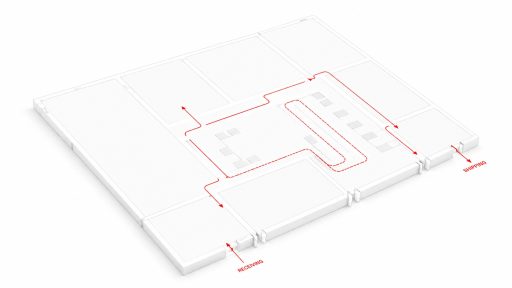
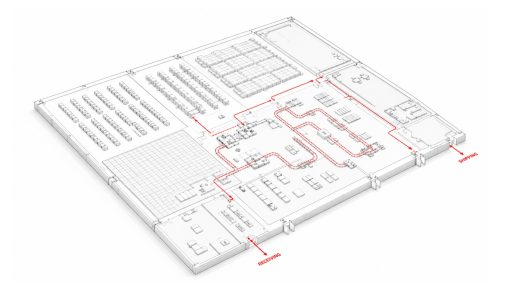
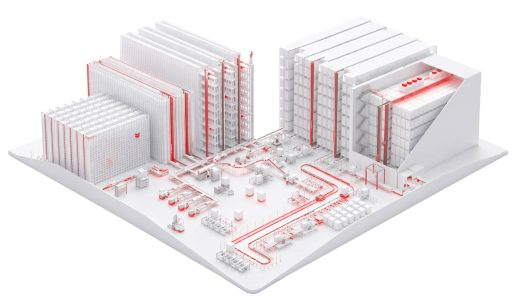
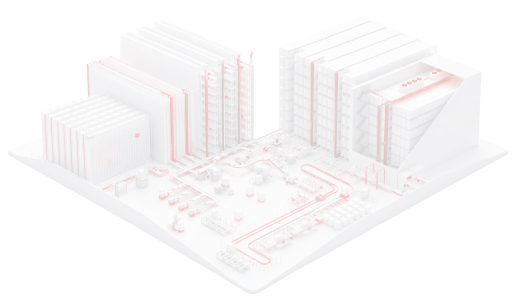
This is where you want to be.
Now understand what it takes to get there.
Everyone wants to see the system running. That’s the easy part to picture. What’s harder to see, and much more important, is everything that happens before that.
Right questions first
There’s an art to asking the right questions.
To build a system that won’t fail, we need to understand everything: your context, your constraints and your limits. So get ready, because we’re going to question it all.
What do you really want to improve: capacity, speed, accuracy or flexibility?
Where are your main pains today?
How does your demand behave (peaks, seasonality)?
How many SKUs do you manage and how do they rotate?
What level of service do you need to deliver?
What physical constraints does your operation have?
Analyze the operation
We have the answers. Now we turn them into something useful: a deep, precise understanding of your operation, built on what you told us.
Operational capacity
Order volume
Demand peaks

Catalog complexity
Number of SKUs
Rotation

Physical constraints
Space
Layout
Height

Future scalability
Growth
Flexibility

Required service level
Lead times
Errors

Would you like us to analyse your situation?
Shape the Solution
Now the solution starts to take shape. Every decision made here defines how the warehouse will perform tomorrow.
Simulate & Validate
Before anything is built,
we make the solution prove itself.
Operational simulation
We simulate the operation under real conditions to test how the system responds before a single piece of equipment is installed.
3D visualization
We turn the future warehouse into something the client can already see, understand and assess in motion.
Real process representation
Flows, sequences and interactions are represented as they will actually happen, making the system visible before it exists.
Validation with the client
Together with the client, we validate performance, capacity and behavior under peak demand. Not as a promise, but as proof.
You don’t imagine your system.
You see it working before it exists.
Space optimization
+0%Order fulfillment capacity
X0Order preparation time
0%reductionOnce the solution has been defined, simulated and validated, we move into execution, go-live and long-term evolution.
Make it real
Detailed engineering, installation and commissioning.
Go live
Training, on-site support and fine-tuning in real conditions.
Grow together
Maintenance, upgrades and continuous improvement over time.
How does
the journey end?
Tell us where you are.
We’ll help you define
what comes next.
-

Book a meeting
Speak with our team and
explore your operation. -

Get a first system definition
Tell us your challenge.
We’ll define the right questions to start. -

Explore real projects
See how complex systems
have been solved.